
From the ancient city of light to the poetic shores of Struga, Lake Ohrid offers one of Europe’s most extraordinary journeys through nature, history, and culture.
Introduction
Nestled on the border between North Macedonia and Albania, Lake Ohrid is one of Europe’s oldest and deepest lakes — a shimmering expanse of crystalline blue-green water ringed by mountains, medieval churches, and timeless villages. In 2010, NASA named one of Titan’s great lakes after it. The lake’s UNESCO World Heritage status reflects what generations of travelers have felt: the water is impossibly clear, the history is layered deep, and the pace of life is exactly what a traveler’s soul needs.
The region is anchored by three towns: Ohrid, the grand historic city clinging to a hillside above the eastern shore; Struga, its quieter, poetic neighbor at the northern end of the lake; and Pogradec, the Albanian lakeside city that earns its nickname as the City of Poetry.
Ohrid: The Jerusalem of the Balkans
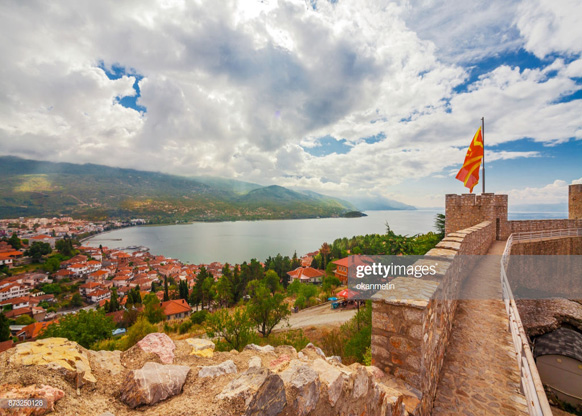
Long celebrated as the “City of Light” — from its ancient name, Lychnidos — Ohrid is also known as the Balkan Jerusalem. The city is said to have once sheltered 365 churches, one for every day of the year. Many still stand, their Byzantine frescoes intact after ten centuries.
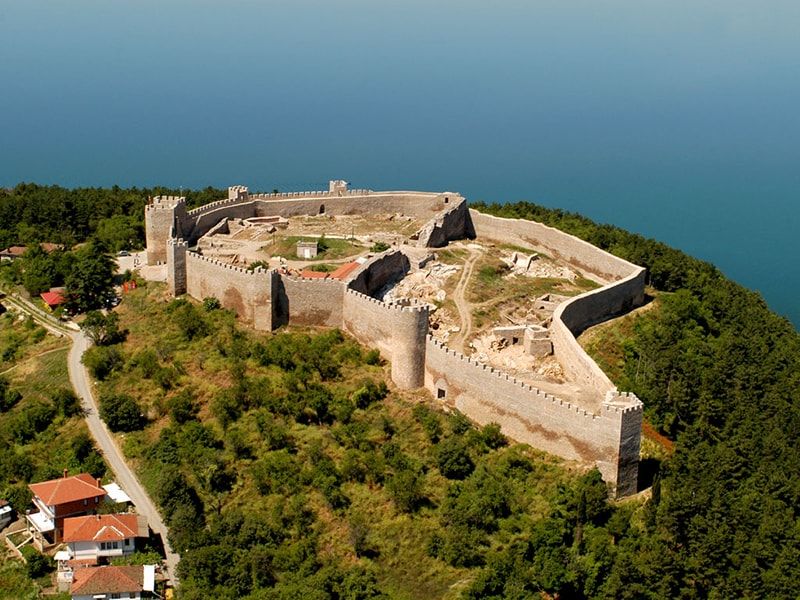
Samuel’s Fortress crowns the hill above the old town, built in the 11th century by Bulgarian Tsar Samuel on foundations dating back to the 4th century BC. Walking the walls offers spectacular panoramas of the lake, and on a clear day you can see far across the water into Albania.
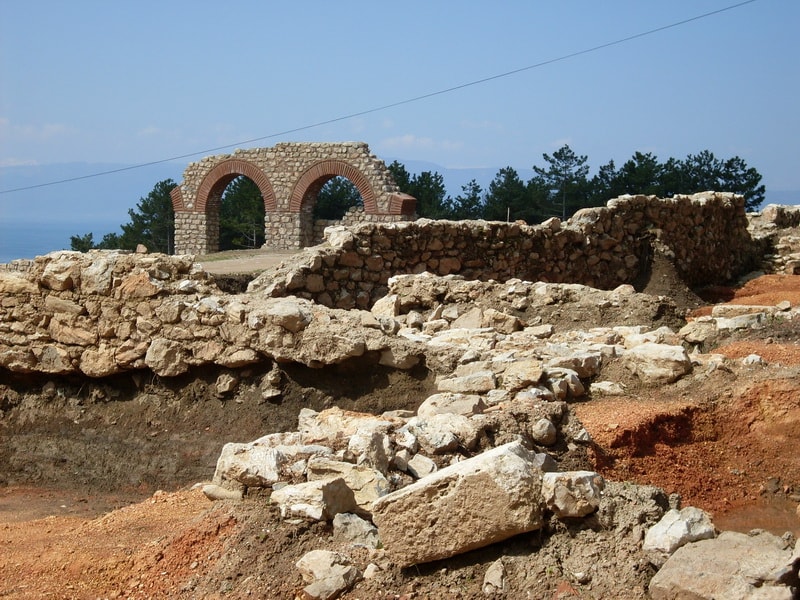
Plaošnik sits tucked in a forested area between the Fortress and the Church of St. John at Kaneo. Archaeological findings here date as far back as the 12th century BC, and it was here that St. Clement taught the very first Slavic script — Glagolitic, the precursor to Cyrillic. Few places in Europe so directly shaped the written culture of an entire civilization.
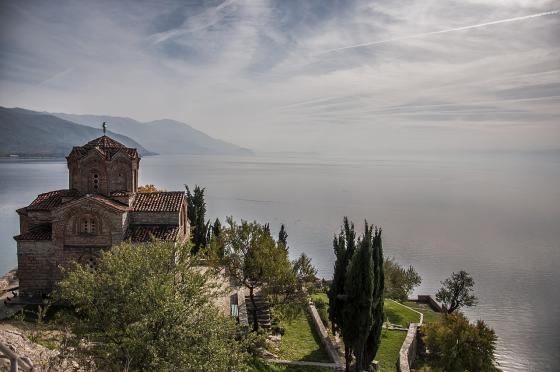
The Church of St. John the Theologian at Kaneo is Ohrid’s most iconic image — a small Byzantine church perched on a cliff above the lake, perfectly framed by water and mountains, and one of the best spots on the lake for sunset.
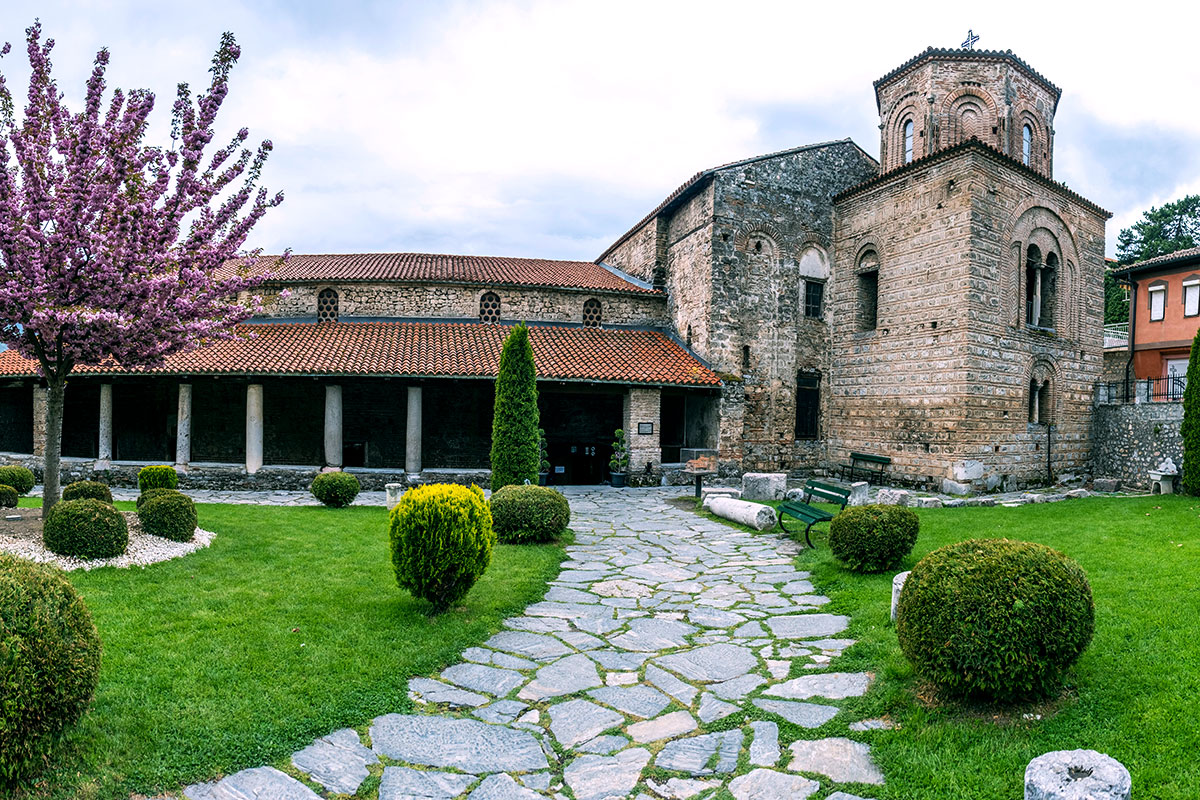
St. Sophia is a masterpiece of Byzantine architecture with fresco cycles from the 11th and 14th centuries. It has lived many lives — cathedral, mosque, museum, and concert hall — and its interior frescoes rank among the most important in Europe.
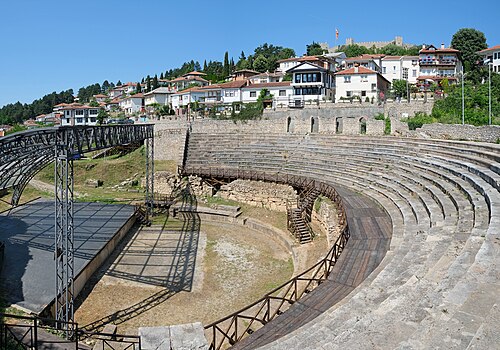
The Ancient Theatre, a Roman theater from the 3rd century BC, was rediscovered in the 1980s and restored. It now hosts summer concerts with the lake shimmering in the background. The National Museum (Robev Family House) covers both ethnography and archaeology, including Greco-Roman artifacts from Plaošnik and grave finds ranging from the 6th century BC to the 3rd century AD. The National Workshop for Handmade Paper offers visitors a hands-on encounter with an ancient craft tradition still practiced today.
The Lake: Beaches, Boats, and the Bay of Bones
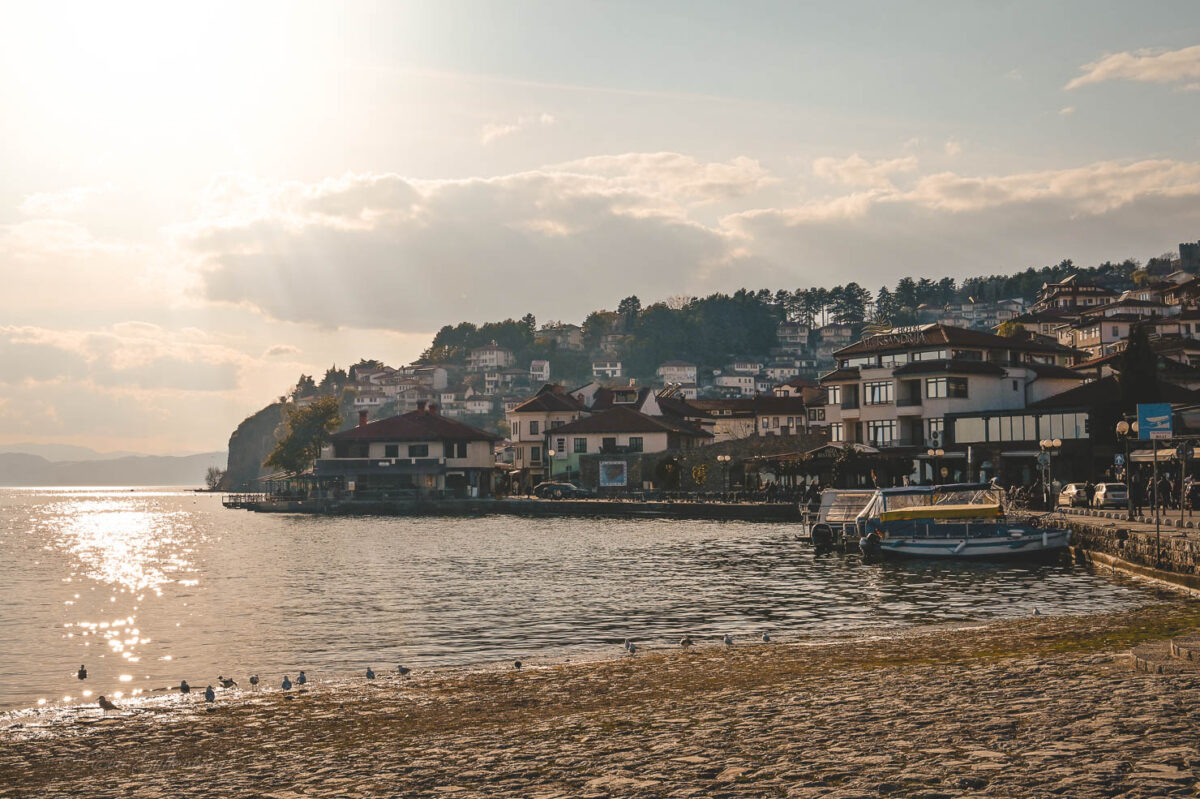
Swimming in Lake Ohrid is one of the region’s great pleasures. Near town, Kaneo Beach sits just below the famous church, while Saraiste and Potpesh beaches lie near the boardwalk. South of Ohrid, a walking promenade leads to Golden Beach, Gorica Beach, and Nemo Beach, all lined with restaurants and bars.
Boat cruises are the finest way to understand the lake’s scale. Ferries depart from Ohrid’s main pier each morning, cruising south past cliff churches, fishing villages, and mountain backdrops.
The Bay of Bones, about 13 km south of Ohrid, is one of Europe’s most extraordinary museums — a Bronze Age village reconstructed on stilts above the lake, based on excavations that revealed 10,000 wooden piles anchored to the lake bed, dating between 1200 and 700 BC. A visit pairs perfectly with the nearby Sveti Naum Monastery, founded in 905 AD, whose church holds the tomb of St. Naum alongside 18th–19th century frescoes. The monastery courtyard is home to peacocks, and a series of freshwater springs nearby bubble up through crystal-clear water teeming with trout — one of the most serene settings on the entire lake.
Struga: The City of Bridges and Poetry
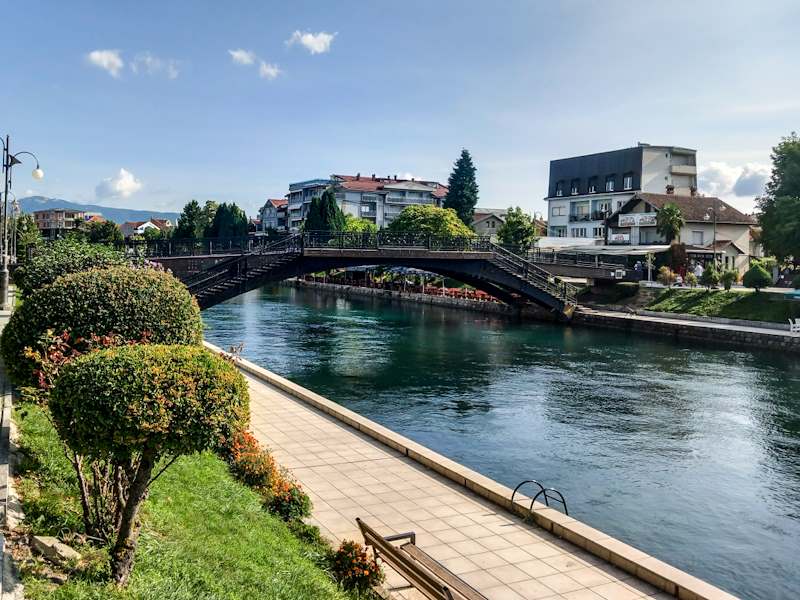
Just 14 km north of Ohrid, Struga is shaped by the river rather than the fortress — a city of poets and fishermen. The Black Drin River flows from the lake straight through the city center, dividing it and giving it its defining character. Strolling along the riverbanks in the evening, with the bridges overhead and café lights reflecting in the water, is one of the most pleasant experiences the lake region has to offer.
Struga’s greatest contribution to the world is the Struga Poetry Evenings, an international festival begun in 1966 that has hosted over 4,000 poets from 95 countries. Every late August, the city hosts readings, multimedia performances, and the prestigious Golden Wreath award ceremony on the Bridge of Poetry, adorned with verses from poets who have attended across the decades. Nobel Prize laureates have been among the recipients.
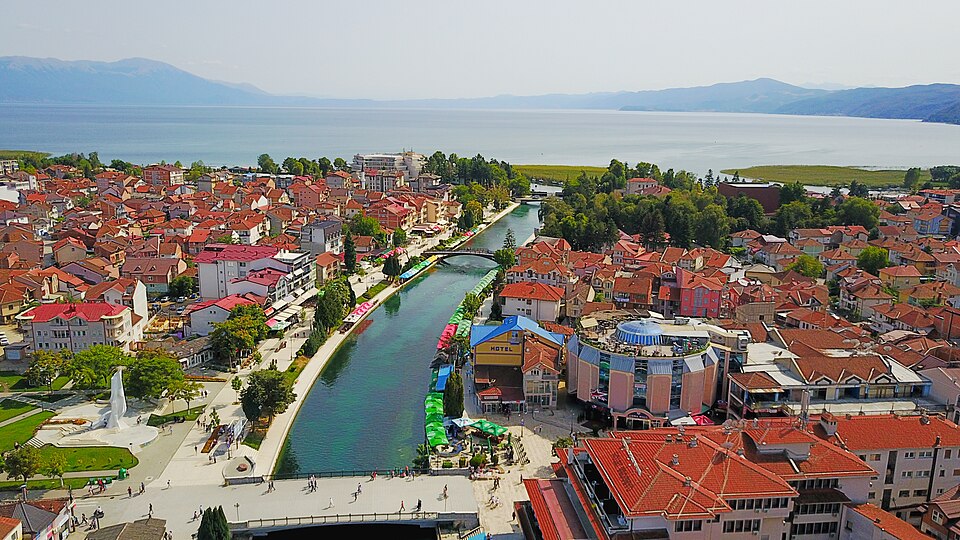
The city is the birthplace of Dimitar and Konstantin Miladinov, two of the most important figures in Macedonian literary history, honored by a dedicated museum in their family home. The Church of St. George, the oldest in Struga, dates to the 14th century and contains richly painted icons. Just outside town, the Monastery of Kališta — a complex of four rock churches with 13th–14th century frescoes — is best reached by boat from the lake. The village of Radoždanearby holds another remarkable rock church with frescoes of comparable age.
Struga has three main beaches — Male, Female, and Galeb — and a long lakeside promenade lined with cafés and restaurants. The local cuisine is built around lake fish, shopska salad, garlic dip (makalo), slow-cooked lamb, and clay-pot tavče gravče.
Pogradec: Albania’s Lakeside City of Poetry
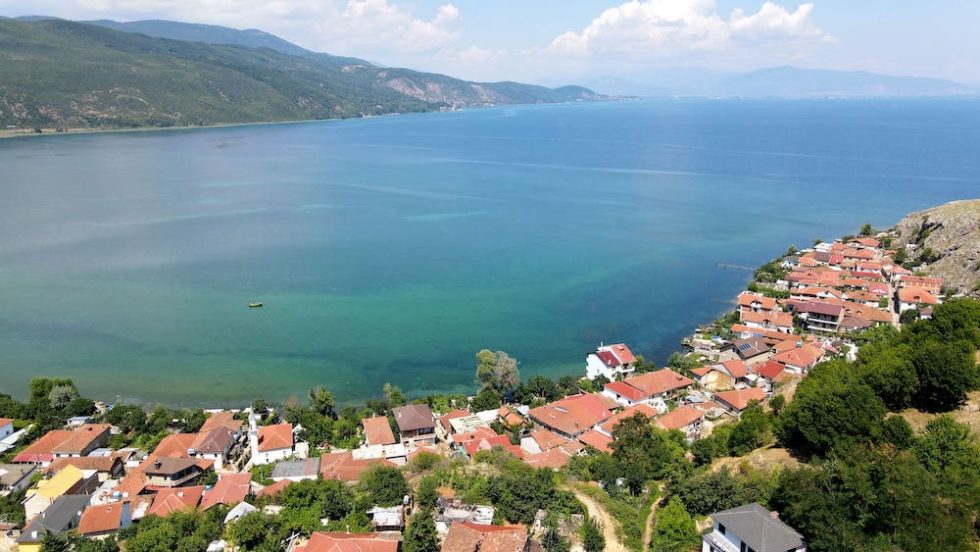
On the Albanian side of Lake Ohrid, Pogradec offers a quieter, more intimate experience. Its name literally means “under the city” — a reference to the Illyrian hilltop settlement that once stood above the current town. The region has been inhabited since around 6000 BC, and during the 5th–4th centuries BC it was the center of the First Illyrian Kingdom.
The lakeside promenade is the heart of daily life in Pogradec, and the town’s sandy beach — rare on this lake — makes it the ideal spot for swimming and sunbathing. Above the town, the Castle of Pogradec offers extraordinary panoramic views over the lake and surrounding mountains.
Drilon National Park, four kilometers east of the city, is a lush oasis of freshwater springs, canals, wooden bridges, and willow trees. Once a private communist-era retreat, it is now open to all, with walking paths, boat rides, and lakeside restaurants. Swans, peacocks, and ducks roam freely through the grounds, and the rippling water and willow scenery make it one of Albania’s most romantic spots.
Adjacent to Drilon, the village of Tushemisht is known for its traditional stone houses, narrow canals, and its role as filming location for the beloved 1976 Albanian film “Zonja nga Qyteti” (The Lady from the City). A bronze statue of the film’s main character, Teto Ollga, stands in the village square.
About 25 minutes north of Pogradec, the village of Lin occupies a rocky peninsula and holds the remarkable distinction of being declared the oldest settlement in Europe — with habitation stretching back over 8,500 years. Above the village stands a 6th-century Byzantine basilica with early Christian mosaics; a former communist bunker at the peninsula’s tip has since been converted into a religious site decorated with Christian artefacts.
The Royal Illyrian Tombs of Selca e Poshtme lie a short distance from Pogradec — monumental structures carved into rock at an elevation of 1,040 meters, dating from the 4th to the 1st centuries BC. They belonged to the Illyrian kings of the ancient city of Pelion, and some feature Ionic columns of striking elegance. The site has been on UNESCO’s tentative list since 1996 and remains one of the most compelling unsung archaeological sites in the Balkans.
The Museum of Pogradec houses three pavilions covering archaeology, ethnography, and history. Among its most remarkable exhibits are two Illyrian helmets of a type of which only 20–30 exist worldwide. No visit is complete without trying koran, the endemic speckled trout of Lake Ohrid found in these waters and nowhere else on Earth, served grilled or baked at the wooden jetty restaurants above the water.
Beyond the Towns
Galicica National Park rises steeply between Lake Ohrid and Lake Prespa, offering hiking trails with views of both lakes simultaneously. Trpejca, south of Ohrid, is a timeless eastern shore village with a beautiful beachfront and a hillside viewpoint. Vevčani, near Struga, is known for powerful natural springs cascading through a forested gorge — and for famously declaring its own independence in 1991. The endemic Ohrid eel, critically endangered, begins its extraordinary migration from Struga’s Black Drin, traveling all the way to the Sargasso Sea in the Atlantic to spawn.
Practical Information
Getting There: Ohrid Airport (OHD) has seasonal European connections. Skopje is about 3 hours by road. Pogradec is 2.5 hours from Tirana and 1 hour from Ohrid via the Qafë Thanë border crossing.
Getting Around: Ohrid’s old town is walkable. Ferries connect Ohrid to Sveti Naum and the Bay of Bones. Taxis run cheaply between Ohrid and Struga. A 15 km cycling path runs along the Albanian shore between Pogradec and its villages.
Best Time to Visit: June–August for swimming and summer festivals. Late August for the Struga Poetry Evenings. Spring and autumn offer cooler weather and fewer crowds.
Currency: Macedonian Denar (MKD) in North Macedonia; Albanian Lek (ALL) in Pogradec. Cash preferred at smaller venues.
A Final Word
Lake Ohrid does not announce itself the way the great European capitals do. What it offers is something harder to manufacture: a genuine sense that you are somewhere old and real, somewhere that has been quietly beautiful for thousands of years and does not need to prove it to anyone. Whether you spend your days climbing Samuel’s Fortress, reading poetry on a bridge in Struga, searching for Illyrian royal tombs above Pogradec, or simply sitting at a lakeside table as the sun sets over the mountains, the lake will find its way into you.