
Category: Travel tips

  • Where the RiverRuns Freeto the Sea

    Where the RiverRuns Freeto the Sea

    From the last wild river in Europe to a spring so clear it defies explanation — and finally to a coastline the world is only beginning to discover.

    VJOSA · BLUE EYE · KSAMIL – SOUTHERN ALBANIA

    Introduction

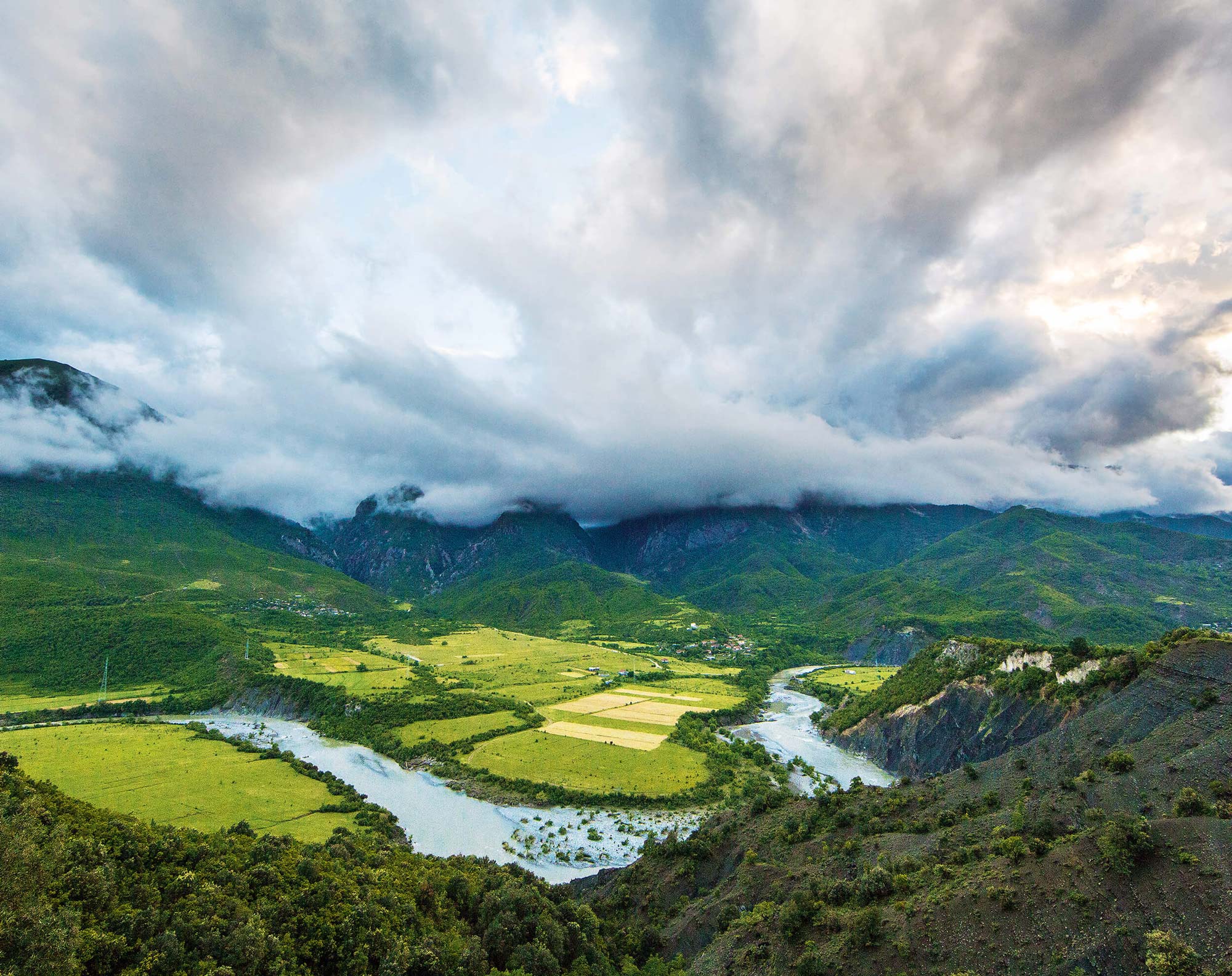
    There is a corner of Europe where the rivers still move exactly as they please. Where mountains drop their meltwater into gorges no dam has ever interrupted, where gravel banks shift with the seasons and sandbars rise and vanish like thoughts. This is southern Albania — one of the continent’s last truly unhurried places, and the setting for one of its most extraordinary journeys.

    The route begins on the banks of the Vjosa, the final great wild river on the European mainland. It passes through the shade of ancient plane trees to the Blue Eye — a karst spring of almost supernatural colour — before descending to Ksamil, a small town of white beaches and turquoise water on the edge of the Ionian Sea. Three stops. Three entirely different encounters with nature. One unforgettable road.

    The Vjosa — Europe’s Last Wild River

    A river that has refused, against enormous pressure, to be tamed.
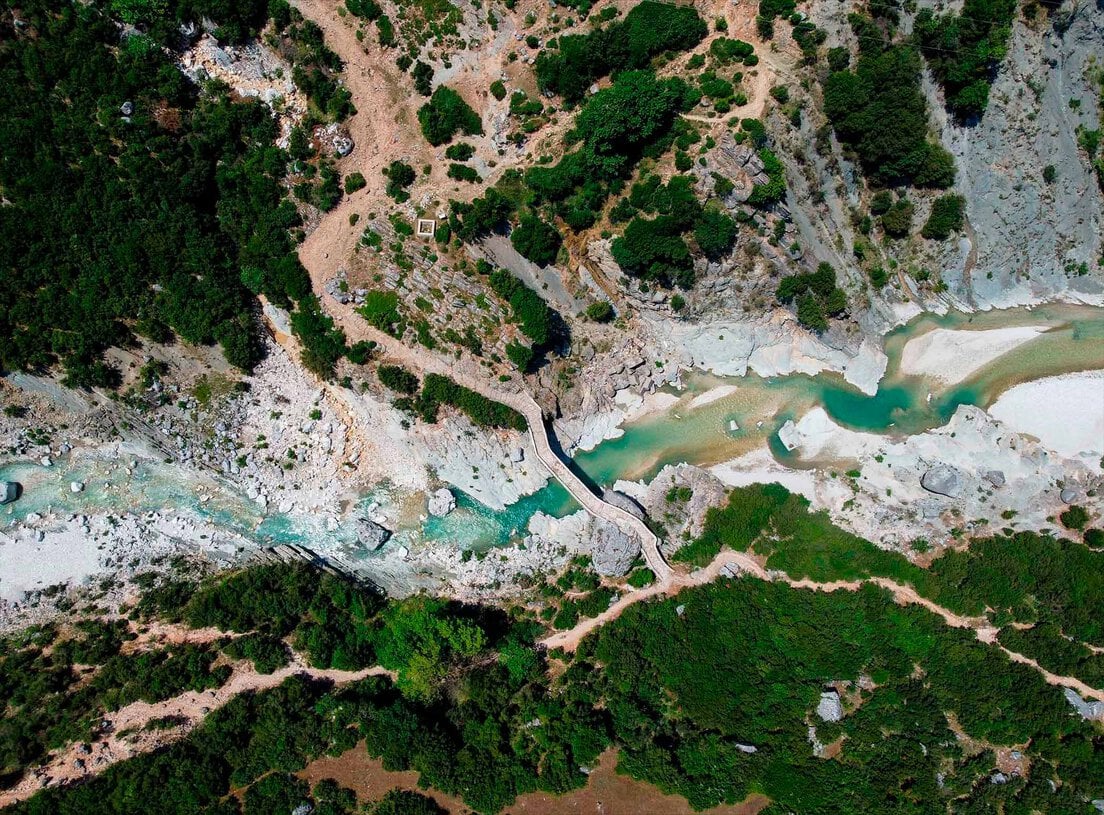
    The Vjosa (also spelled Vjosha, or Aoos in Greek) is not merely a river. It is a statement. Rising in the Pindus Mountains of northern Greece, it crosses into Albania near Çarshovë and flows north-westward for 272 kilometres in total — 192 of them through Albanian territory — before emptying into the Adriatic north of Vlorë. Its water quality is the best in the country, suitable for all uses, and its crystal clarity is visible from a great distance: the river meanders through pale sand and gravel banks in broad, braided channels, forming small islands, splitting into arms, and rejoining with an unhurried confidence.

    What makes the Vjosa extraordinary in a European context is precisely what it lacks: interruption. Across the continent, almost every river of this size has been fragmented by dams, straightened for navigation, or drained for agriculture. The Vjosa and its tributaries flow freely along the entire stretch from source to sea — a 400-kilometre network of wild waterways that supports over 1,000 species and at least eight habitat types classified as the highest conservation priority in the European Union.
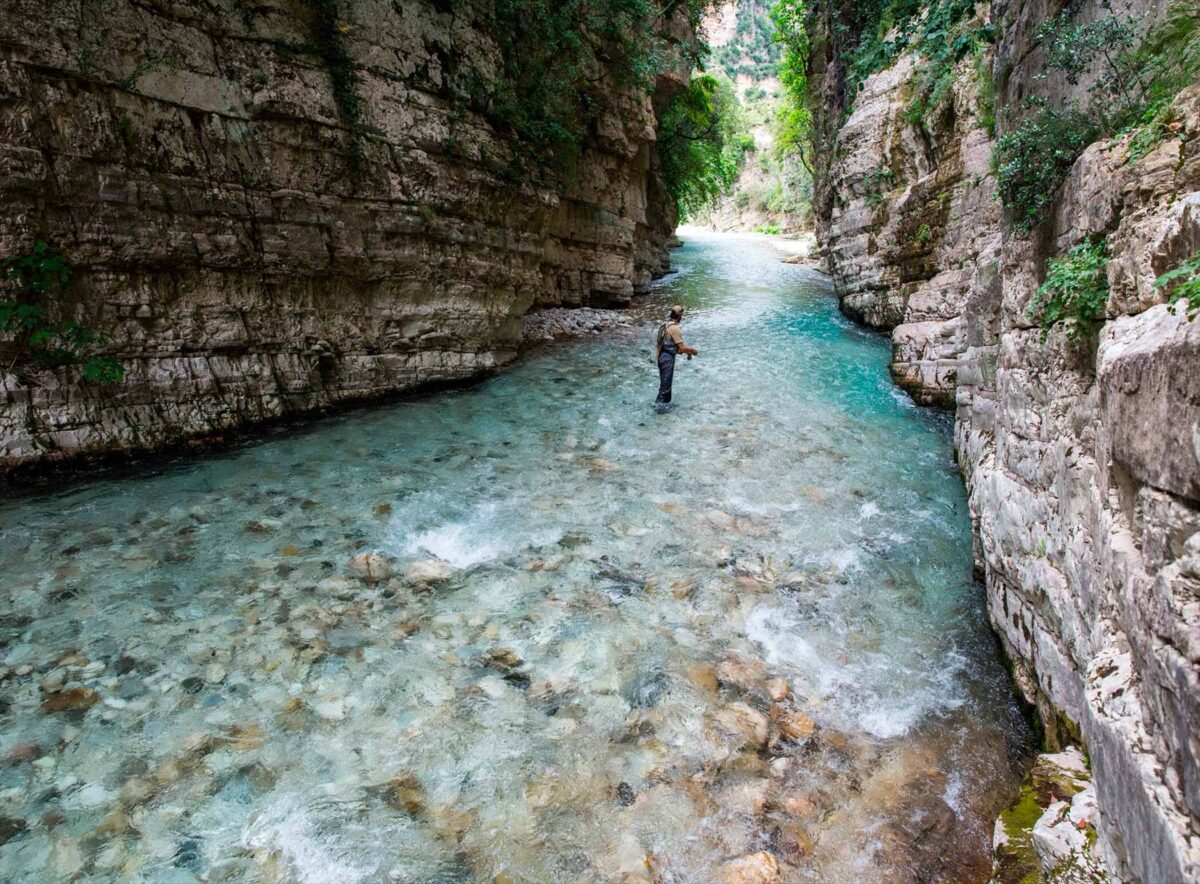
    In its middle course alone, the riverbed stretches wider than ten football pitches in places. Narrow gorges in the upper section give way to wide gravel plains and sandbanks, then a naturally functioning delta on the Adriatic coast. The Këlcyra Gorge, where the river cuts through limestone cliffs east of Tepelena, is perhaps the most dramatic passage: a medieval castle once controlled this chokepoint, and the Romans before that built their settlements along the same route.

    The town of Përmet is the Vjosa’s cultural heart. Known as the greenest and cleanest city in Albania — and affectionately called the “City of Roses” — it sits nestled in the valley with a population of just over 10,000. It is famous for its folk music, its preserved desserts called gliko, its local wine and raki, and the remarkable Ottoman-era Katiu Bridge that spans the nearby Lengarica River.

    “The Vjosa’s rich environment is home to playful otters, threatened Egyptian vultures, and microscopic organisms — 13 animal species and two plant species assessed as globally threatened by the IUCN.”

    Just south of Përmet, at the foot of the Katiu Bridge, lie the Benja Thermal Baths — three natural pools fed by the Lengarica River and said to have therapeutic properties. Locals have bathed here for generations, and the setting, in the shade of the gorge with the Ottoman arch overhead, is unlike anything you are likely to find elsewhere in Europe.
    For the more adventurous, the Vjosa is the finest rafting and kayaking river in the Balkans. Multi-day kayak expeditions travel the full Albanian length of the river from the Greek border to the Adriatic, camping on gravel banks and swimming in pools of startling clarity. Even a three-hour whitewater rafting tour from Përmet provides a memory that will not fade quickly.

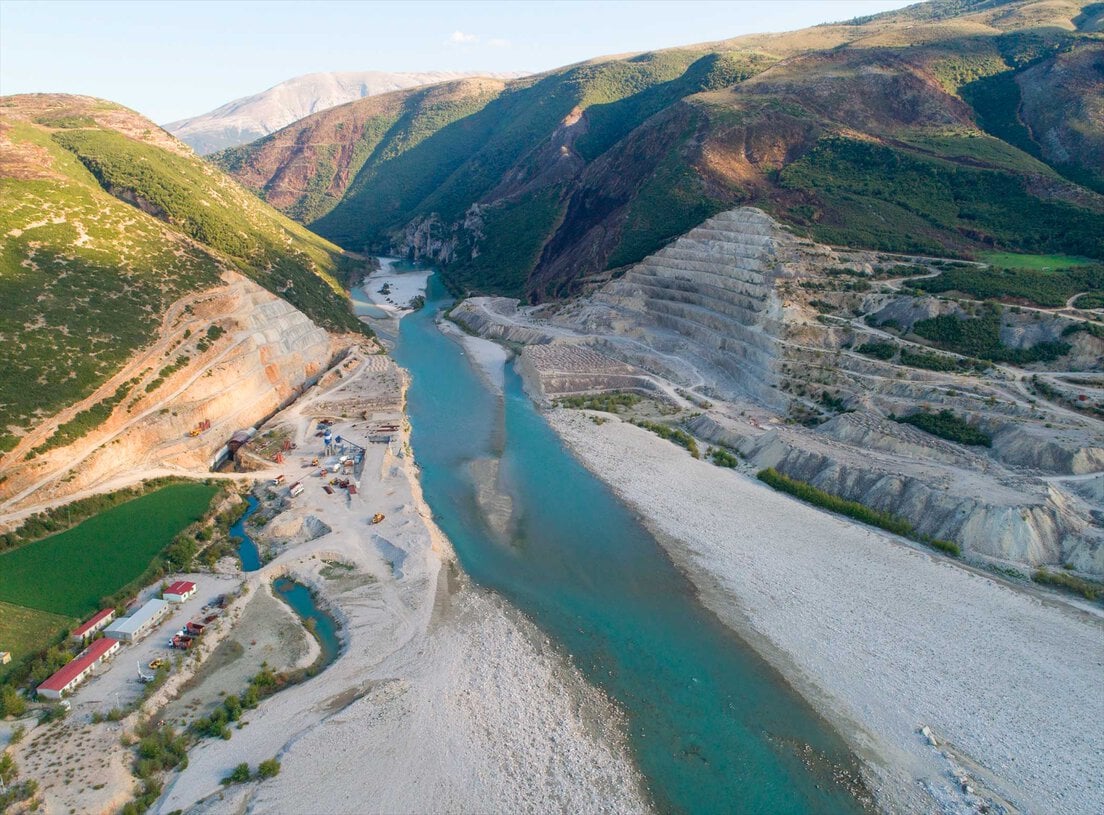
    The Vjosa’s survival has not been accidental. For decades, there were plans for 40 hydropower plants within the catchment area — nine on the Vjosa itself, and 31 on its tributaries. Three tributaries have already been lost to dams. The river’s protection became an international cause, backed by conservation organisations, scientists, and eventually the outdoor brand Patagonia, which co-signed a declaration of intent with the Albanian government in June 2022. In March 2023, Albania formally established Europe’s first Wild River National Park on the Vjosa — a decision hailed by National Geographic, the Guardian, and Lonely Planet alike as a historic moment for river conservation.

    The Vjosa Valley is also an archaeological landscape. The ancient Illyrian hill town of Byllis sits high above the river in Mallakastra, one of the most beautiful historical sites in Albania. The Leusa Church of St Mary, two kilometres from Përmet, is a late 18th-century monastery surrounded by dense forest, its interior covered in Orthodox icons and frescoes — a cultural treasure accessible only on foot or by off-road vehicle.

    Syri i Kaltër — The Blue Eye

    A spring so deep, so cold, and so perfectly blue that legend has always found it before science did.
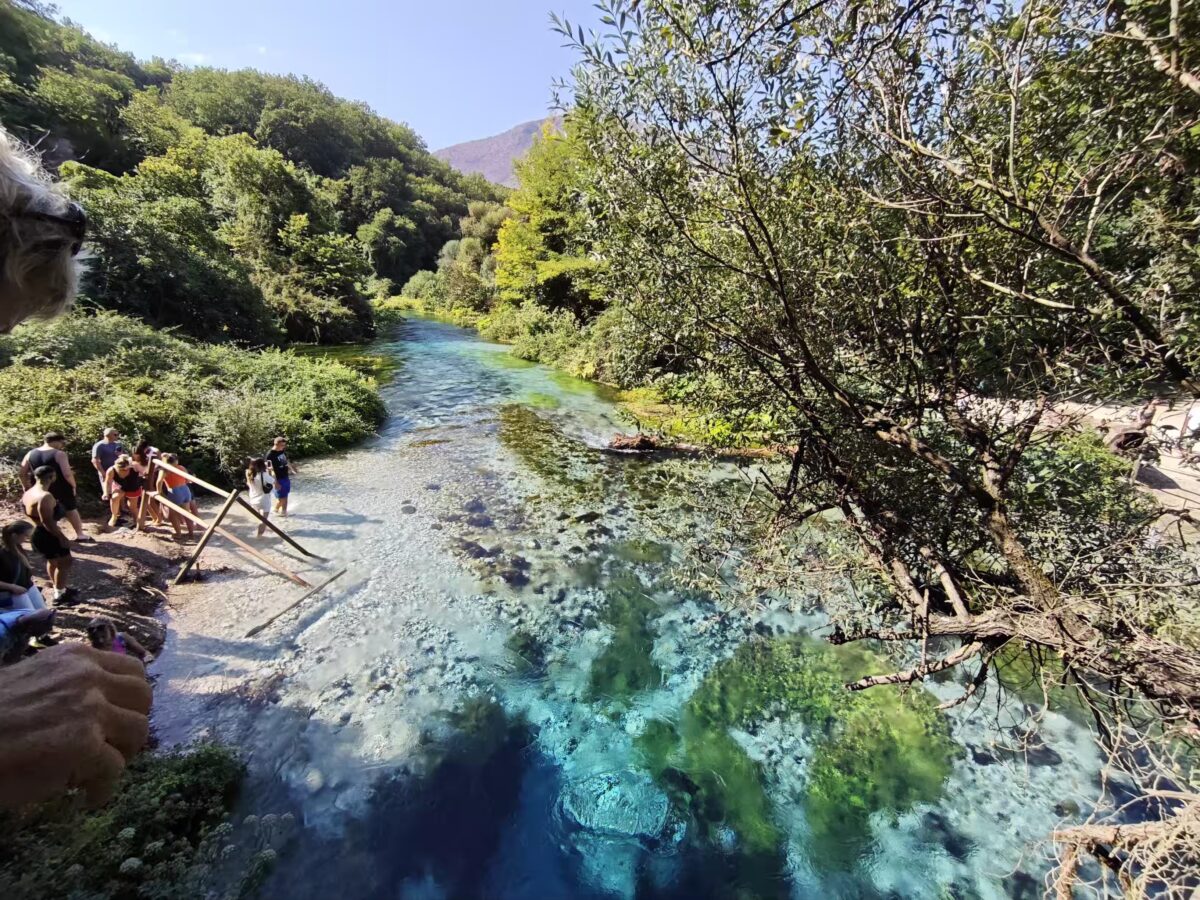
    From Përmet, the road south follows the Drino valley toward Gjirokaster, then sweeps toward Sarandë. But between those two cities, near the village of Muzinë at the western foot of Mali i Gjerë, the mountain keeps a secret. The Blue Eye — Syri i Kaltër in Albanian — is a karst spring of a kind that has no real parallel in Europe. Cold, crystal-clear water rises from a vertical shaft of unknown depth, surging upward with such force that it creates the impression of a cauldron boiling in slow motion, though the water is ice-cold.

    The spring emerges at the point where the karst limestone of Mali i Gjerë meets an impermeable rock formation below. Because the underground karst system is far larger than the visible topographic basin above it, more water flows from the spring than falls as rainfall in the immediate area — the coefficient of flow reaches 1.21, meaning the Blue Eye draws on precipitation from the entire eastern slope of the mountain, which percolates through an enormous network of underground caverns before erupting upward in this single, spectacular source. This is where the Bistrica River is born.
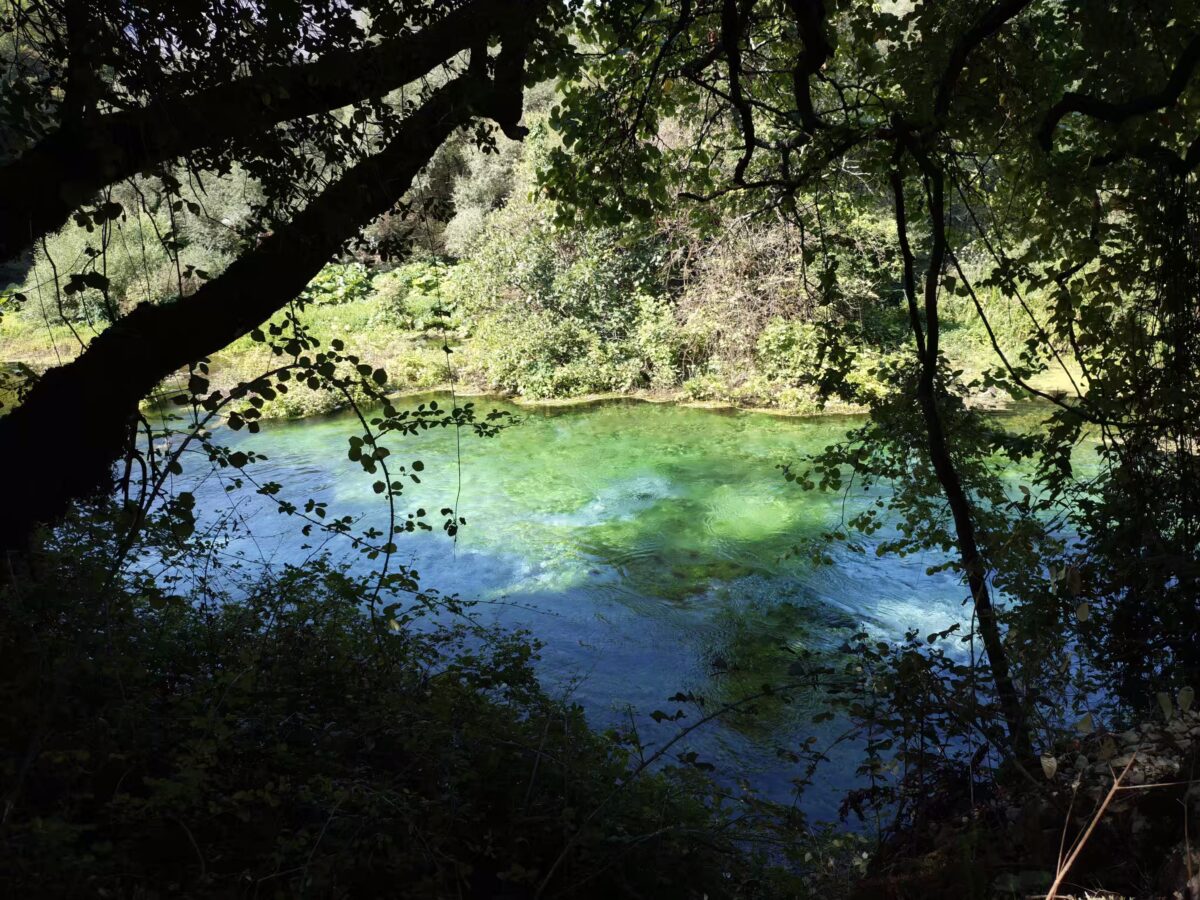
    The spring’s average annual discharge is 6 cubic metres per second. At its centre — the bebja, or pupil — the water appears almost black-blue, a colour produced by the depth and the angle of light descending into the shaft. Moving outward from the centre, the water brightens through cobalt and turquoise before settling into a pool ringed by ancient Oriental plane trees (Platanus orientalis), oaks, and a dense, almost jungle-like undergrowth of Mediterranean vegetation. The effect is such that the boundary between water and forest is genuinely difficult to determine.

    There are eighteen karst springs in the immediate area, but the Blue Eye is the largest and most dramatic by a considerable margin. In 2022, the Albanian government upgraded its protected status from a natural monument to a full natural park, expanding the protected area from 180 to 293 hectares. Within this ecosystem, researchers have recently identified species new to Albania, including a rare bat species, alongside at least seven natural habitat types and several endemic plant species.

    “From antiquity to today, people have seen this spring as a beginning of life. Near the ancient cities of Finiq and Butrint, it may well have served as a ritual centre — a place where offerings were made to the gods of water.”

    The human relationship with the Blue Eye runs back to antiquity. The spring’s proximity to the ancient cities of Finiq and Butrint suggests it may have functioned as a site of religious ritual — a place where offerings of wine, tools, and animals were made to the water gods. Today, people still throw coins into the pool for good luck, a gesture that connects the modern visitor to a thread of reverence stretching back thousands of years. Even for those who arrive without any knowledge of this history, the spring produces an instinctive hush: something about the depth and colour of the water demands a moment of quiet.
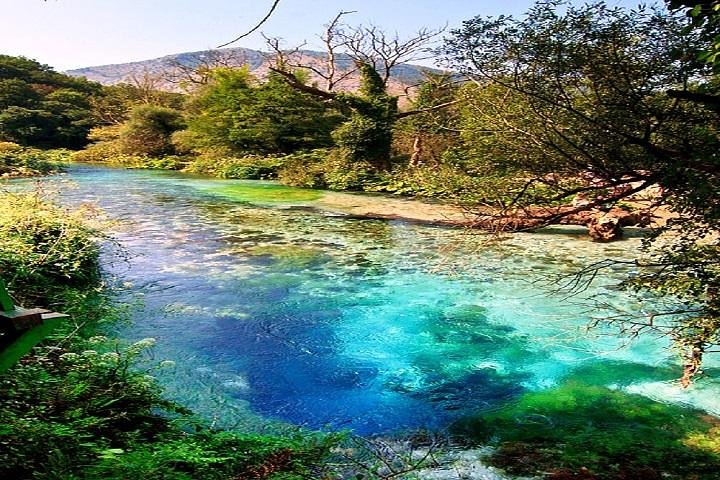
    The walk through the park to reach the spring follows a shaded forest path along the Bistrica stream. It takes only a few minutes from the car park, but the transition — from the sunny Albanian road into cool, green shade — is immediate and total. On hot summer days, the temperature at the spring is noticeably lower than anywhere nearby. The water itself maintains a constant temperature throughout the year.

    Ksamil — The Pearl of the Albanian Riviera

    Where the Ionian Sea turns a colour that seems impossible until you are standing in it.
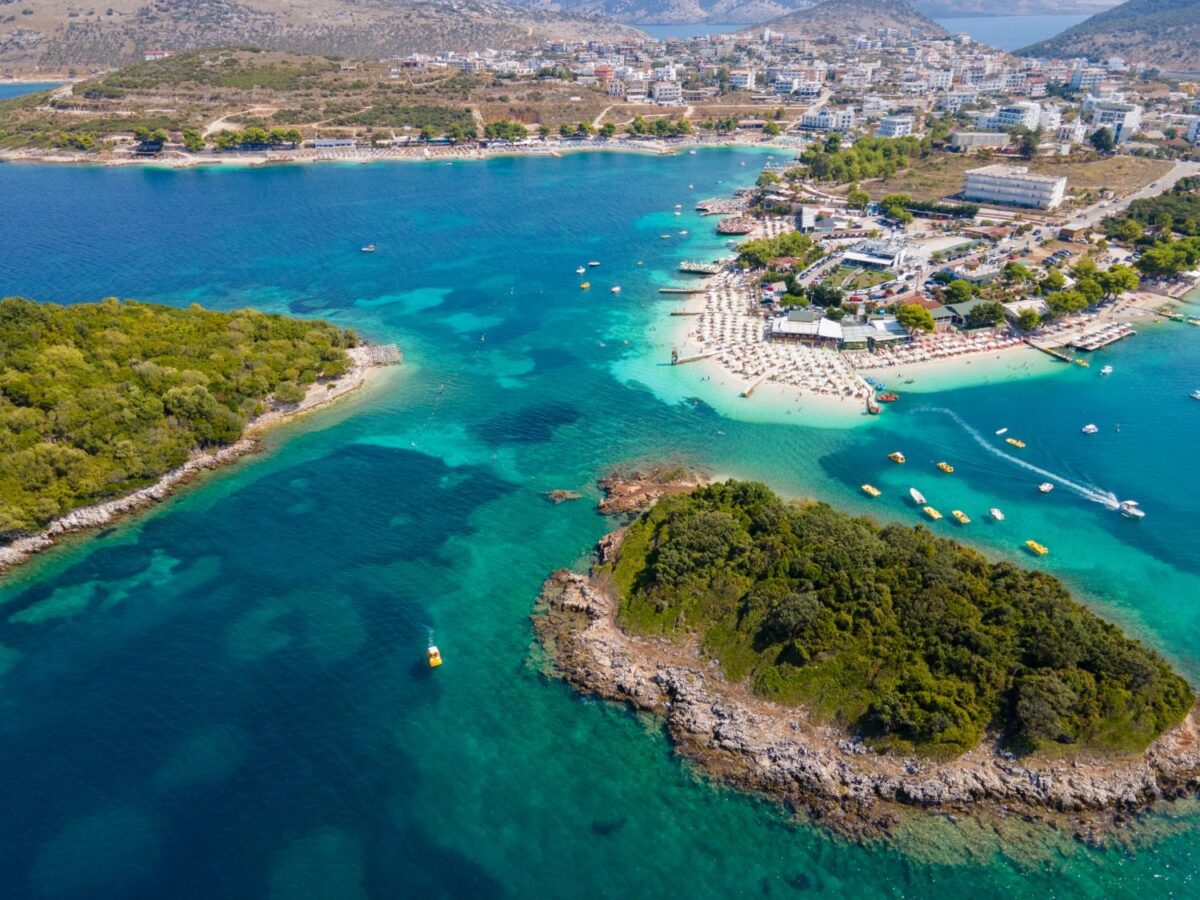
    The final descent to Ksamil is one of the most anticipated moments on the Albanian Riviera — and it delivers. The town sits south of Sarandë, at the end of the road that leads toward the Butrint archaeological park, perched between the Ionian Sea to the west and the freshwater lagoon of Butrint to the east. The result is a landscape that is, quite literally, surrounded by water: the Ionian channel separating Albania from Corfu to the west, and the calm, reed-fringed lagoon to the east. From an aerial perspective, Ksamil appears almost as an island.

    The beaches — long, white-sand stretches separated by small rocky headlands — face directly across the narrow channel toward Corfu. The water here is shallow and extraordinarily clear, warming quickly in summer and maintaining the vivid turquoise that has earned Ksamil comparisons with the Maldives in Albanian travel writing — hyperbolic, perhaps, but not entirely without basis when the light is right and the sea is calm. Elevations range from 7.5 to 15 metres above sea level on the small offshore islands, which are covered in dense Mediterranean scrub.
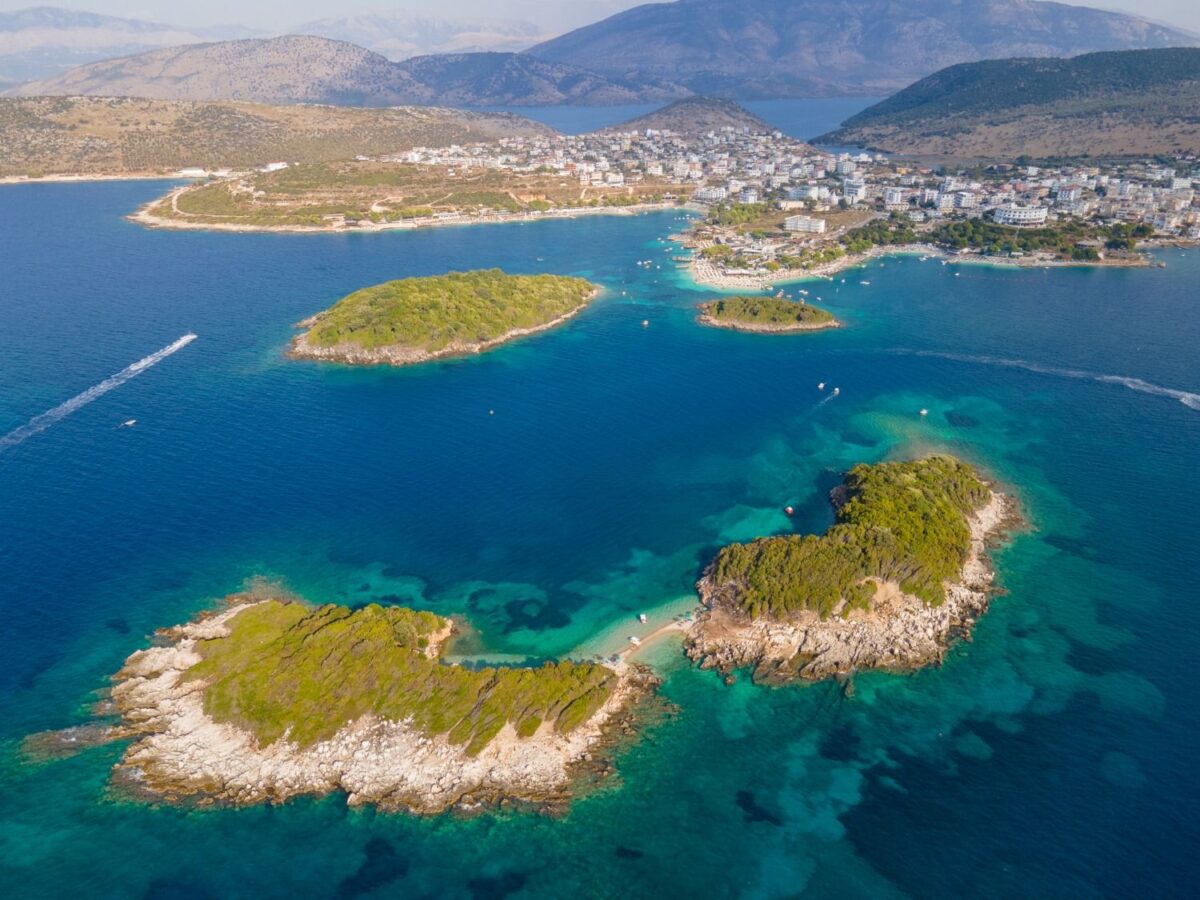
    Those islands — three small rocky outcroppings known simply as the Three Islands — are the iconic image of Ksamil and easily accessible by a short swim or a boat taxi from the beach. Their vegetation is characteristically Mediterranean: low, wind-sculpted shrubs, wild herbs, and in spring, flowers that attract insects from the mainland. Between the islands and the shore, the sea floor is clear enough to read the texture of the sand below. Snorkelling here reveals a world of colourful coral formations, diverse fish, and, in some areas, submerged historical relics — a reminder that the Ionian has been a thoroughfare of civilisations for millennia.

    Ksamil was, until relatively recently, a small fishing village best known as the access point for the Butrint archaeological park. Butrint, a UNESCO World Heritage Site, is one of the most remarkable archaeological sites in the Mediterranean — a walled city that was inhabited continuously from the Bronze Age through the Ottoman period, its ruins now managed within a national park of extraordinary natural beauty. The two sites together — Butrint and Ksamil — form a combination that is difficult to match anywhere on the European coast.

    “Ksamil is surrounded by water — the Ionian Sea to the west, the magnificent lagoon of Butrint to the east. Its crystalline waters, the famous Three Islands, and the channel toward Corfu make this one of the Riviera’s most complete destinations.”
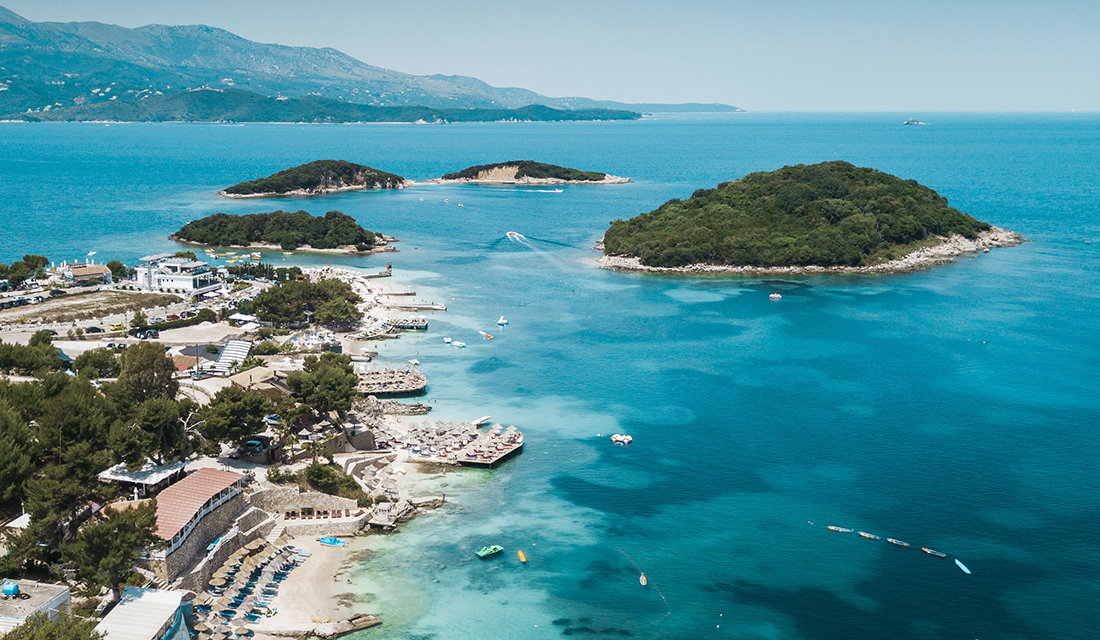
    For hikers, the slopes above Ksamil and the tracks along the Albanian Riviera offer a different kind of engagement with the landscape: following the curves of the coastline on foot, with views down to coves that can only be reached by swimming or climbing. The area rewards those who move slowly, who are willing to leave the main beach for the half-hidden bays in either direction along the shoreline.

    The town’s culinary character is built around the sea. Fish restaurants line the waterfront — sea bream, sea bass, octopus, and locally caught shellfish — most of them with terraces that look directly out over the channel toward the Greek island. The Albanian coast produces a distinctive style of seafood dining: generous, unhurried, and priced at a fraction of comparable restaurants across the Adriatic in Italy or Greece.

    Ksamil is family-friendly in the truest sense — the shallow, sheltered waters near the beach are gentle enough for children, the distances between restaurants and accommodation are short, and the pace of life during the summer months is relaxed without being dull. The town has grown rapidly in recent years, its reputation spreading across Europe by word of mouth, and in summer the streets and beaches fill with visitors from across the continent. Yet even at its most crowded, the quality of the water and the presence of the Three Islands keeps Ksamil feeling like somewhere that genuinely earns its visitors’ admiration.
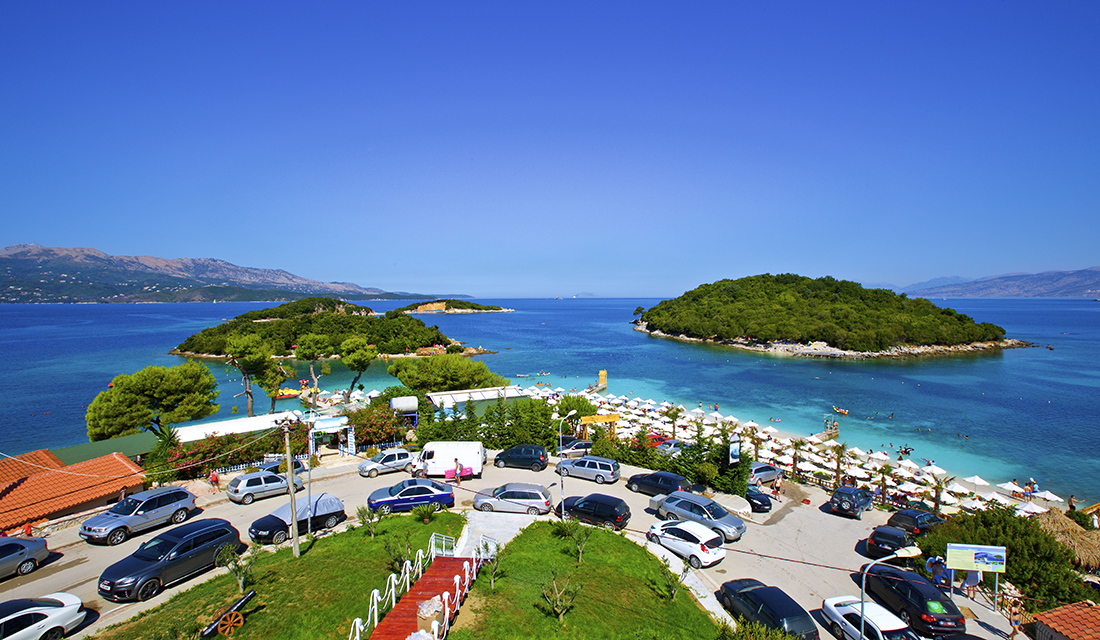
    At the end of an afternoon on the beach, as the light flattens and turns gold over Corfu and the Ionian ripples purple in the early evening, it becomes clear why this corner of Albania — wild river, blue spring, turquoise sea — is quietly becoming one of the continent’s most treasured journeys.

    How to Connect the Three

    The natural route from Tirana runs south on the national highway through Fier and Vlorë, then into the Vjosa Valley via Tepelenë. Allow at least a full day in and around Përmet — the Benja Thermal Baths and Katiu Bridge alone merit a morning. Continue south through Gjirokastër (a UNESCO World Heritage city in its own right, worth an overnight stop) and join the road toward Sarandë. The Blue Eye is signposted off the Gjirokastër–Sarandë highway near Muzinë — it is a short detour that should not be rushed. Ksamil lies 20 kilometres south of Sarandë.

    The road conditions on the main southern axis are generally good; the secondary roads into the Vjosa Valley require more patience. A rental car, ideally with decent ground clearance, gives by far the most freedom. Bus connections exist from Tirana to Përmet and to Sarandë, but timing and frequency limit flexibility. The journey is best done over four to five days, allowing the landscape — which shifts dramatically from mountain river to forested karst spring to Ionian coastline — to settle properly before moving on.

    Southern Albania asks little of its visitors except attention. The reward, in return, is access to a version of Europe that is almost entirely unspoiled: a wild river that Europe fought to protect, a spring of impossible colour, and a sea that the rest of the world is only beginning to find.
  • Tirana Budva

    Tirana Budva

    Tirana ↔ Budva — Travel Guide
    Complete Travel Guide

    Tirana to Budva

    · · ·

    Albania to Montenegro’s Adriatic crown jewel — history, beaches, and the legend of Sveti Stefan

    Tirana ↔ Budva

    The two cities are roughly 185 km apart by road — a manageable journey with stunning mountain and coastal scenery along the way. The route passes through Shkodër, crosses the Albanian-Montenegrin border, and winds down toward the Adriatic. No trains exist on this route; your options are bus, private shuttle, or car.

    🚌 Budget

    Direct Bus

    • From Tirana East Terminal (near TEG Mall)
    • Departs ~05:00 AM & 03:00 PM daily
    • Journey: ~5–7 hrs (border included)
    • Cost: €20–30 per person
    • Operators: FlixBus, Gjirafa, Diamant Travel
    • Arrives at Budva Central Bus Station
    🚐 Comfort

    Private Shuttle

    • Picks up from city centre / airport
    • Departs ~2:15 PM from Skanderbeg Square
    • Journey: ~4–5 hrs
    • Requires min. 4 passengers
    • Operator: Montenegro Hostel Travel Agency
    • Book online in advance
    🚗 Flexible

    Rental Car

    • Drive time: ~3.5 hrs (border excl.)
    • Car rental from €20–25/day in Tirana
    • Requires cross-border permission
    • Buy Green Card insurance at border (€15)
    • July/August prices are significantly higher
    • Taxi: €130–160 fixed price

    🗺️ Border Crossing Tips

    • Most buses cross at Sukobin (MNE) / Muriqan (AL) — one of the smaller, faster crossings.
    • Everyone exits the bus at both Albanian and Montenegrin checkpoints. Have your passport ready.
    • Peak summer weekends can add 1–2 hrs to border wait times. Plan accordingly.
    • Montenegro uses the Euro (€). No Schengen visa required for most nationalities.
    • Download offline maps before you go — WiFi at bus stations is unreliable.
    • Book bus tickets in advance in peak season — seats fill up fast.

    The Story of Budva

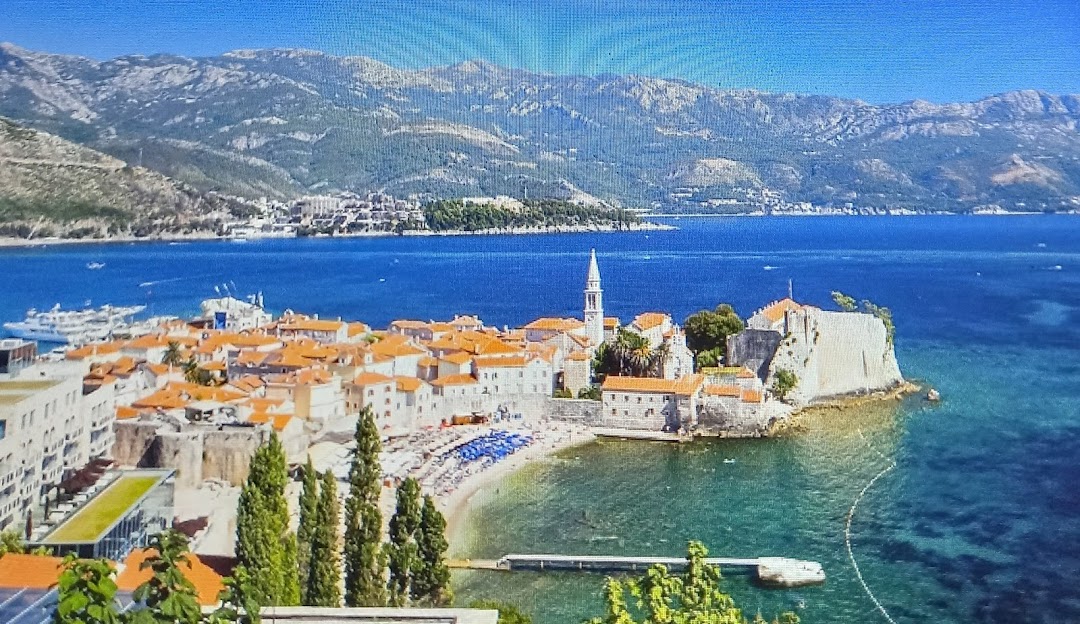
    Few towns on the Adriatic can match Budva’s depth of history. One of the oldest continuously inhabited settlements on the coast, it has been shaped by mythic legend, Greek traders, Roman soldiers, Venetian merchants, and modern tourism.

    The Myth of Cadmus

    Ancient legend holds that Budva (then called Bouthoe) was founded by Cadmus — son of the Phoenician king Agenor and brother of Europa. Exiled from Thebes after failing to rescue his sister from Zeus, Cadmus followed the Oracle of Delphi’s instructions to follow a cow with a moon-shaped marking. Where the cow lay down, he founded a city — which he shared with his wife, the goddess Harmonia. Greek playwrights Sophocles and Euripides both referenced this founding myth.

    1

    5th Century BC — Illyrian Roots

    The earliest written records of Budva date to the 5th century BC. The site originally belonged to the state of Illyria. During the Greek colonisation of the Adriatic in the 6th century BC, a Greek trading post (emporium) was established here.

    2

    2nd Century BC – 6th Century AD — Roman Era

    In the 2nd century BC, the area was absorbed into the Roman Republic, and from 27 BC into the Roman Empire. When the Empire split east and west, the dividing line ran directly through this region — leaving a lasting mark on Budva’s culture. In the 6th century, it fell under Byzantine rule.

    3

    841 AD — The Saracen Sack

    Muslim Saracen raiders sacked and devastated Budva in 841. In subsequent centuries, the town passed through the hands of Doclean kings and Serbian and Zetan nobles. Around 1200 it became the seat of the Roman Catholic Diocese of Budua.

    4

    14th Century — Albanian Rule

    The Albanian Zaharia family briefly controlled Budva in the 14th century, alongside the Balšić family — a reminder of the deep historical ties between the towns of this coast and Albanian nobility.

    5

    1420–1797 — Nearly 400 Years Under Venice

    The Republic of Venice ruled Budva (calling it Budua) for nearly four centuries. The Venetians fortified the city with powerful walls against Ottoman conquest — the very walls visible today. Most residents spoke Venetian dialect into the early 19th century. Budva briefly fell to Ottoman forces in 1572–73 but was returned to Venice under the Treaty of Constantinople.

    6

    19th–20th Century — Austrian & Yugoslav Rule

    After Venice fell to Napoleon in 1797, Budva passed briefly through French and Russian hands before falling under Austro-Hungarian rule for nearly a century until liberation in 1918. It was then incorporated into Yugoslavia, which transformed the region into one of the socialist state’s premier tourist destinations.

    7

    1979 — The Great Earthquake

    A devastating earthquake struck the Montenegrin coast, heavily damaging Budva’s Old Town. Much of what is seen today is a meticulous reconstruction — a testament to how deeply the locals valued preserving their ancient city.

    8

    Today — The Adriatic Riviera

    Modern Budva is Montenegro’s undisputed tourism capital — a blend of 2,500-year-old walls, sandy beaches, boutique restaurants, and a vibrant summer nightlife. The coastal stretch known as the Budva Riviera draws visitors from across Europe.


    Sveti Stefan — History & Legend

    Six kilometres southeast of Budva, rising from the Adriatic on a sandy isthmus barely wider than a road, sits one of Europe’s most photographed landmarks. The island of Sveti Stefan is part fortress, part film set, part living history.

    Origins (15th century): The first record of Sveti Stefan dates to 1442, when it served as a coastal fortress for the Paštrovići tribe — a local Montenegrin clan. According to legend, the settlement was founded after the Paštrovići defeated a Turkish galley crew; with the captured treasure, each of the tribe’s twelve clans built a house on the island. The settlement was named after the Church of Saint Stephen (Stefan Prvomučenik), built during the Nemanjić dynasty. Cannons and cannon openings preserved on the island today are the lasting reminders of its defensive past.

    Venetian Protectorate: By 1423 the Paštrovići community had become a protectorate of the Republic of Venice. The island was fortified against repeated Ottoman attacks, virtually destroyed during the fourth Ottoman-Venetian War and rebuilt in the 16th century. It also served, for a time, as a haven for Adriatic pirates.

    From Fortress to Resort: By the 19th century a village of around 400 people had grown on the island. During WWII, Sveti Stefan was occupied by Italian and German forces and suffered significant damage. By the mid-1950s, the population had dwindled to just 20 residents. In 1955, the Yugoslav government made the remarkable decision to relocate the remaining inhabitants to the mainland and convert the entire island into a luxury hotel — a “town-hotel” unlike anything in the world. The streets, walls, roofs, and facades kept their original appearance; the interiors were modernised.

    The Celebrity Years: From the 1960s through the 1980s, Sveti Stefan became one of Europe’s most exclusive and glamorous resorts. Among its guests: Sophia Loren, Marilyn Monroe, Elizabeth Taylor, Princess Margaret of England, King Umberto II of Italy, Sylvester Stallone, Kirk Douglas, Doris Day, Claudia Schiffer, Jeremy Irons, chess master Bobby Fischer, and Soviet cosmonaut Yuri Gagarin. In 1972, it was awarded the “Golden Apple” — named the most exclusive summer resort in the world.

    Decline and Rebirth: The breakup of Yugoslavia in the 1990s brought the resort into decline. In 2007, Aman Resorts won the international contract to revitalise the island, completing meticulous renovations by 2009. The resort closed again in 2021 amid disputes between local residents (who demanded public beach access) and the private management. After years of negotiation, Aman Sveti Stefan is set to reopen in summer 2026 — with two beaches now open to the public.

    Distance from Budva
    ~6 km southeast
    Island Size
    12,400 m² footprint
    Type
    Tombolo (sandy isthmus)
    Status (2026)
    Reopening July 2026

    📸 Visiting Sveti Stefan as a Non-Guest

    • The iconic viewpoint along the main coastal road (near St. Sava Church) offers the best panoramic photo of the island — completely free.
    • The public beach directly facing the island is one of the most photogenic on the Adriatic. Bring a picnic and spend an afternoon.
    • From Budva you can walk the coastal path south — about 1.5 hrs of gorgeous seaside walking.
    • Boat tours from Budva often include a close approach to Sveti Stefan.
    • Nearby restaurants like Adrovic Restaurant offer meals with direct island views at reasonable prices.

    Best Things to Do in Budva

    From medieval alleyways to the Adriatic’s finest beaches, Budva rewards every kind of traveller.

    🏰

    Explore Old Town

    Wander the cobblestone streets of Budva’s walled old city — another jewel of Venetian architecture on the Adriatic. Walk the city walls, duck into tiny churches, and explore boutique shops and local restaurants in the labyrinthine lanes.

    🏛️

    The Citadel (Citadela)

    Climb Budva’s citadel for panoramic views over the Old Town, the beaches, and the Adriatic. Inside you’ll find a small maritime museum and a historic library. Open 9 AM–midnight. Entry ~€5.50.

    🏖️

    Mogren Beach

    A short walk west of Old Town along a scenic cliff path leads to Mogren — two beaches joined by a tunnel carved through limestone. One of Budva’s most beautiful and dramatic settings. Arrive early in peak season.

    🌊

    Jaz Beach

    A few kilometres west, Jaz is the largest and most spacious beach near Budva. With calm, clear water, beachside restaurants, and free areas of sand, it’s ideal for a full beach day. Famous for hosting major music festivals.

    🌅

    Slovenska Beach

    The long main beach right in Budva town centre. Lined with sunbeds, bars, and a promenade, it’s bustling but convenient. Perfect for an evening stroll as the sun sets over the Adriatic.

    Boat Tours & Water Sports

    Take a boat tour from Budva harbour along the Riviera, stopping at Sveti Stefan, sea caves, and secluded coves. Kayaking, paddleboarding, and jet skis are widely available along the beaches.

    Church of St. Ivan

    The oldest and most significant church in Budva, dating to the 9th century. Located inside Old Town, it holds important religious artefacts and sits alongside the Church of the Holy Trinity, one of the prettiest Orthodox churches on the coast.

    🥾

    Hike to St. Sava Peak

    A steep but rewarding 40-minute hike above Sveti Stefan. The summit offers the single best panoramic view of the island and the Adriatic. A 15th-century church near the top adds historical drama. The bell here once rang in times of danger.

    🍷

    Eat & Drink in Old Town

    Budva’s Old Town restaurants serve fresh Adriatic fish, grilled meats, and local Montenegrin wine. Look for black risotto (crni rižoto), fresh sea bass (brancin), and prosciutto from Njeguši. Avoid peak dinner hour queues by eating before 7 PM.

    🌙

    Nightlife

    Budva is Montenegro’s nightlife capital in summer. The Old Town fills with music after midnight; beach clubs host DJ nights and live acts. Troubadur (in the Old Town) is legendary for live folk and pop music in a magical outdoor setting.

    🏔️

    Day Trip: Kotor

    Just 25 km north, the medieval walled city of Kotor sits at the end of a dramatic fjord-like bay. A UNESCO World Heritage Site and arguably the most beautiful town in Montenegro. Take an early bus or taxi.

    🏔️

    Day Trip: Lake Skadar

    The Balkans’ largest lake — shared between Montenegro and Albania — is a short drive away. Take a boat tour through reed beds and past medieval fortified villages and monasteries. A paradise for birdwatchers (280+ species).


    Must-Haves in Budva

    If time is short, these are the experiences you cannot leave without.

    01

    Walk the Old Town at Golden Hour

    The light on the Venetian stone walls at dusk is extraordinary. Walk the full circuit of the old city walls, then duck inside the gates for a drink in one of the tiny squares. This is Budva at its most timeless.

    02

    See Sveti Stefan from the Viewpoint

    Even if you don’t set foot near the island, you must stop at the panoramic viewpoint above it. One of the most iconic views on the entire Adriatic coast — the terracotta rooftops against the blue sea is unforgettable.

    03

    A Morning on Mogren Beach

    Get there by 9 AM before the crowds arrive. The walk along the cliff path from Old Town is itself worth the effort. Swimming in the clear turquoise water beneath the limestone cliffs is one of those memories you keep forever.

    04

    Fresh Seafood in the Old Town

    Sit outside at one of the restaurants just inside the old city walls and eat fresh-caught Adriatic fish with local wine. This is the essential Budva meal. Try the grilled sea bass or a mixed fish plate.

    05

    A Boat Trip Along the Riviera

    The Budva Riviera looks completely different from the water. A 2–3 hour boat tour reveals sea caves, deserted coves, and the true drama of the coastline. The approach to Sveti Stefan from the sea is extraordinary.


    A 3-Day Itinerary in Budva

    Whether coming from Tirana for a long weekend or using Budva as a base for the whole Riviera, here’s how to make the most of it.

    Day 1

    Arrival & Old Town

    Morning Depart Tirana (East Terminal) on the early bus (~05:00 AM). Enjoy the mountain and coastal scenery. Arrive Budva by late morning. Check into your accommodation.
    Afternoon Old Town: Enter through the main gate and lose yourself in the cobblestone lanes. Visit the Church of St. Ivan, climb the Citadela for panoramic views (open 9AM–midnight), and walk along the city walls.
    Evening Dinner in Old Town: Choose a terrace restaurant inside the walls — order fresh fish and local wine. Then wander the Riva (seafront promenade) as the lights come on and the evening comes alive.
    Day 2

    Beaches & Sveti Stefan

    Early AM Mogren Beach: Walk the cliff path from Old Town and arrive early for the best spot. Swim in the clear water, then hike back for breakfast at a café in Old Town.
    Midday Drive or taxi south to Sveti Stefan (~15 min). Stop at the panoramic viewpoint above the island. Walk the coastal path to the public beach facing the island — perfect for photos and an afternoon swim.
    Afternoon Hike to St. Sava Peak for the ultimate bird’s-eye view of Sveti Stefan and the Riviera (~40 min steep hike). Visit the 15th-century church at the summit. Descend and have a cold drink at a local café.
    Evening Return to Budva for dinner. If you have energy, explore the summer nightlife in and around Old Town — the Troubadur club is legendary for live music under the stars.
    Day 3

    Jaz Beach, Boat Tour & Departure

    Morning Jaz Beach: Head west to Budva’s largest and most spacious beach for a relaxed morning swim. Walk to the quieter coves at the eastern end for full seclusion.
    Midday Boat tour departing from Budva harbour (~2–3 hrs). Cruise along the Riviera, past Sveti Stefan from the sea, and into hidden sea caves and coves. Pack sunscreen.
    Afternoon A final coffee and seafood lunch on the Riva. Pick up local olive oil, wine, or prosciutto from the market as a souvenir.
    Evening Depart for Tirana on the afternoon bus (~03:00 PM). Arrive back in Tirana by evening. Alternatively, add a night in Kotor or extend your stay.

    🕐 Best Time to Visit

    • May & September are the sweet spot — warm seas, far fewer crowds, reasonable hotel prices.
    • June–August is peak season: beaches get extremely packed (especially from Eastern European tourists), hotels are at maximum price, and Budva traffic is intense.
    • For parking by car: try “Parking kod hotela WOW” — 1 block from the seafront, €1/hr, 10-min walk to Old Town.
    • April & October: quieter and charming, though some beach bars close and rain is possible.

    Travel Guide: Tirana ↔ Budva  ·  Montenegro Adriatic Riviera

    Sources: Wikipedia, Rome2Rio, Visit Montenegro, Aman Resorts, European Heritage Days, Travel blogs. Always verify transport schedules before travel.